


B
Try feedback!
Great and versatile semi modular synth! Make sure you try feedback routing to get the most out of it. Send the output into EXT IN, crank up EXT Level, and mess around with the wavefolder. Send it through one of the attenuverters to experiment with negative feedback instead.
2
0
Report
E
If one mono synth then this one
The best mono module I could find.
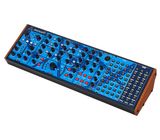
I can see why it's more expensive than polyphonic pro-800 - all the patch sockets, buttons and leds cost money. The lights look fantastic in darker room.
UPDATE after 1 year:
It's a real deal. The company should stop doing countless clones and do more innovation like this. All the mono clones are more or less the same: 2 VCOs, 1 VCF, 1 VCA, 1-2 LFO, ADSR for filter, ADSR for amplifier. Proton has all that and more.
Proton can be a base for modular setup, its internal modules are fully accessible, and there are more modules than in any of the Behringer clones. It's possible to learn modular technology using Proton only, and it is the cheapest way.
The 2 VCF can be 3 different filters: one single filter is 12 db/octave, two in parallel is 6 db/octave, 2 in series is 18 db/octave.
I wish Behringer made a similar system with modular utils to combine with Proton, with things like mixers, buffered multiplies, proper MIDI to CV, S&H, effects, etc.
But for now it's possible to combine Proton with a Tiptop Audio Happy Ending Kit rack, and add any needed additional modules there.
Notes:
1) The MIDI input would be better if CV/Gate output was exposed on the patch panel. Then it would be possible to drive external modules. But it's wired internally to VCOs, VCFs and ADSRs. For an expansion with external modules, a separate MIDI to CV module is needed.
2) Each oscillator has a "sub-oscillator" one octave lower, and it can not be turned off completely, even in software. It seems to be possible via MIDI codes, but I didn't manage to figure it out. The sub-oscillators don't affect sound much on the lowest settings, but they do make graphs on an oscilloscope confusing.
3) Behringer packed too many features into a small box which make it a bit unintuitive. Reading manual is necessary: the routing and modulation logic is not obvious from front panel, and there are essential hidden key combinations. There is also good guidance on youtube.
4) The hardware quality is good, it holds, the knobs are solid. However the marks on the knobs are made with paint, and on some knobs it's hard to see them. I will need to figure out something to make the marks more visible.
I can see why it's more expensive than polyphonic pro-800 - all the patch sockets, buttons and leds cost money. The lights look fantastic in darker room.
UPDATE after 1 year:
It's a real deal. The company should stop doing countless clones and do more innovation like this. All the mono clones are more or less the same: 2 VCOs, 1 VCF, 1 VCA, 1-2 LFO, ADSR for filter, ADSR for amplifier. Proton has all that and more.
Proton can be a base for modular setup, its internal modules are fully accessible, and there are more modules than in any of the Behringer clones. It's possible to learn modular technology using Proton only, and it is the cheapest way.
The 2 VCF can be 3 different filters: one single filter is 12 db/octave, two in parallel is 6 db/octave, 2 in series is 18 db/octave.
I wish Behringer made a similar system with modular utils to combine with Proton, with things like mixers, buffered multiplies, proper MIDI to CV, S&H, effects, etc.
But for now it's possible to combine Proton with a Tiptop Audio Happy Ending Kit rack, and add any needed additional modules there.
Notes:
1) The MIDI input would be better if CV/Gate output was exposed on the patch panel. Then it would be possible to drive external modules. But it's wired internally to VCOs, VCFs and ADSRs. For an expansion with external modules, a separate MIDI to CV module is needed.
2) Each oscillator has a "sub-oscillator" one octave lower, and it can not be turned off completely, even in software. It seems to be possible via MIDI codes, but I didn't manage to figure it out. The sub-oscillators don't affect sound much on the lowest settings, but they do make graphs on an oscilloscope confusing.
3) Behringer packed too many features into a small box which make it a bit unintuitive. Reading manual is necessary: the routing and modulation logic is not obvious from front panel, and there are essential hidden key combinations. There is also good guidance on youtube.
4) The hardware quality is good, it holds, the knobs are solid. However the marks on the knobs are made with paint, and on some knobs it's hard to see them. I will need to figure out something to make the marks more visible.
0
0
Report
DV
Amazing mono-synth
One of the best mono synths you can have at this price. If you combine it with the Neutron then the capabilities are mind blown
0
0
Report