


Korg microKORG S



One month of full access to Syntorial for free – learn synth programming like a video game
When you purchase this product between 15.07.2026 and 15.10.2026, you receive a free 30-day full trial of Syntorial, the interactive ear-training software for synth programming.
Instead of just watching videos, you recreate leads, basses, pads and more. Get instant feedback as you learn how oscillators, filters, modulation and effects work together to create real patches.
Your personal voucher code will be sent automatically by e-mail after your order. No credit card required. The trial ends automatically after expiry.
This offer is available in English, French, Spanish, and Japanese.
Analog Modeling Synthesis System
- 37 Velocity sensitive slim keys
- 2 Oscillators and noise generator
- Vocoder: 8 Bands
- Max. polyphony: 4 Voices
- Integrated 2 + 1 speaker system for optimal sonority
- 256 Programs - 192 presets / 64 Users
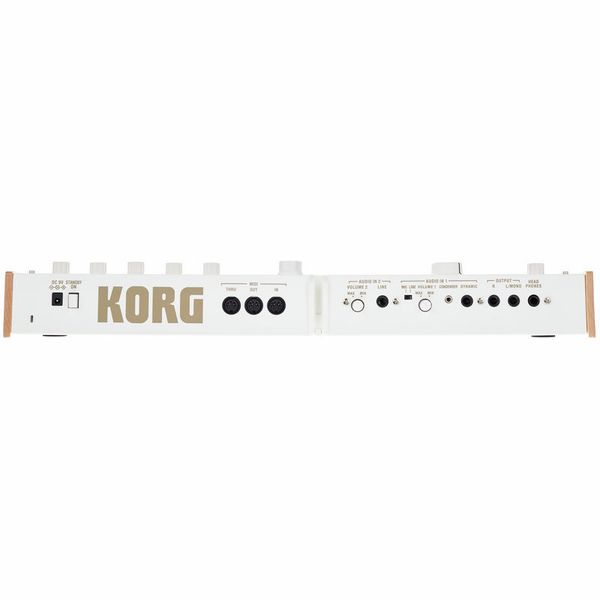
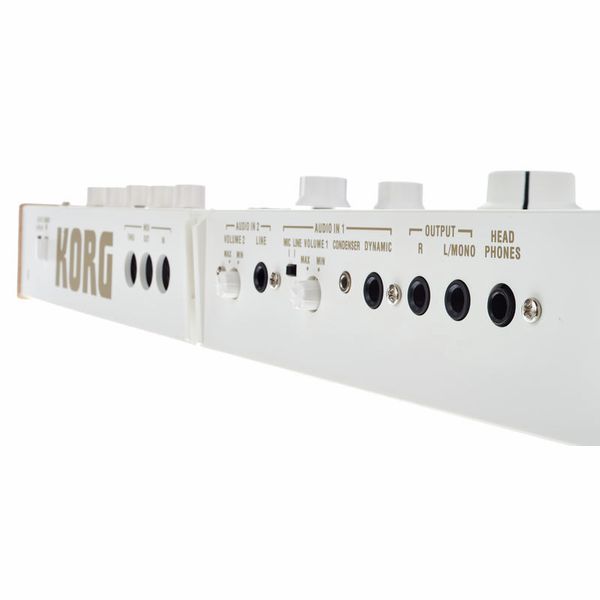
- Audio Input
- Stereo output
- MIDI: In / Out / Thru
- Optional battery operation (6 x AA batteries)
- Dimensions (W x D x H): 524 x 232 x 70 mm
- Weight: 2.5 kg
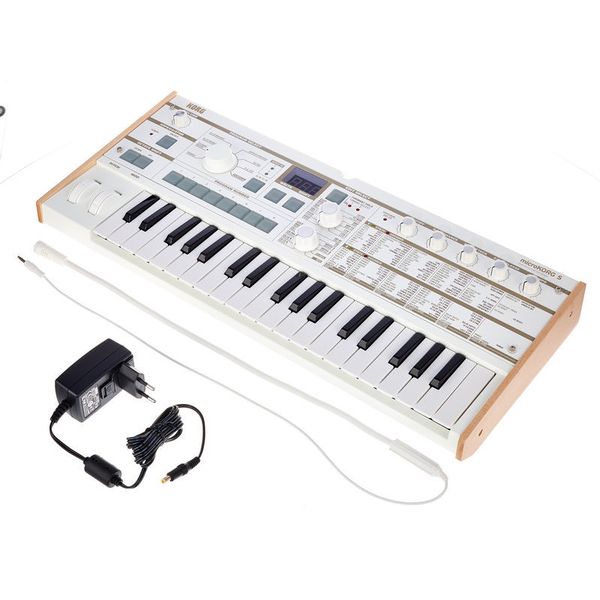
- Incl. power supply and gooseneck microphone
Effects:
- Modulation: 3 Types
- Delay: 3 Types
- Equalizer
- Arpeggiator: 6 Types
-
Available since October 2016
-
Item number 398386
-
Sales Unit 1 piece(s)
-
Number Of Keys 37
-
Touch-Sensitive Yes
-
Aftertouch No
-
Split Zones No
-
Modulation Wheel Yes
-
Number of simultaneous Voices 4
-
Sound Engine Virtual Analogue
-
MIDI interface 1x In, 1x Out, 1x Thru
-
Storage Medium None
-
USB-port No
-
Effects 1x Multi Effect Processor
-
Arpeggiator Yes
-
Number of Analog Outputs 2
-
Digital Output No
-
Display Yes
-
Pedal Connections None
-
Dimensions 524 x 232 x 70 mm
-
Weight 2,2 kg
-
Compact synth with speakers and vocoder
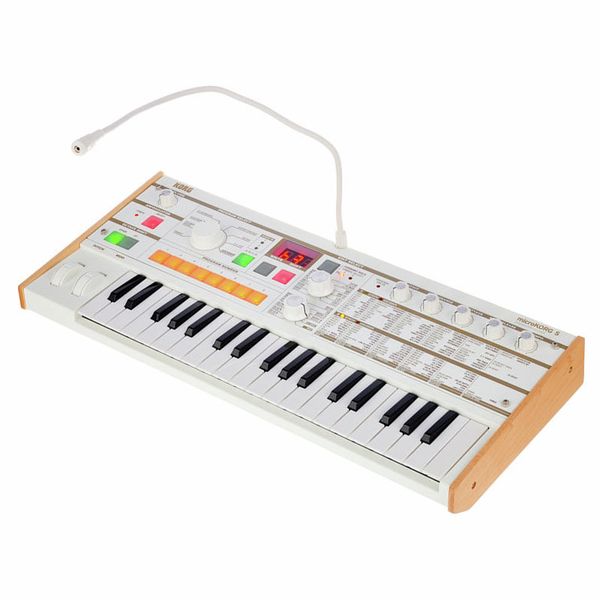
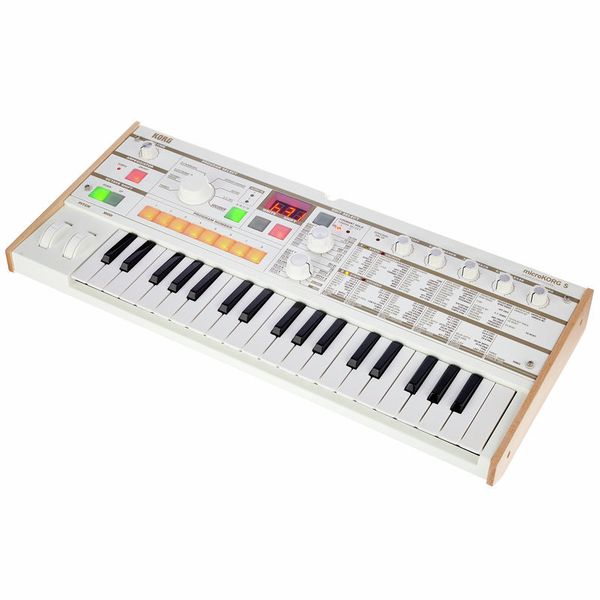
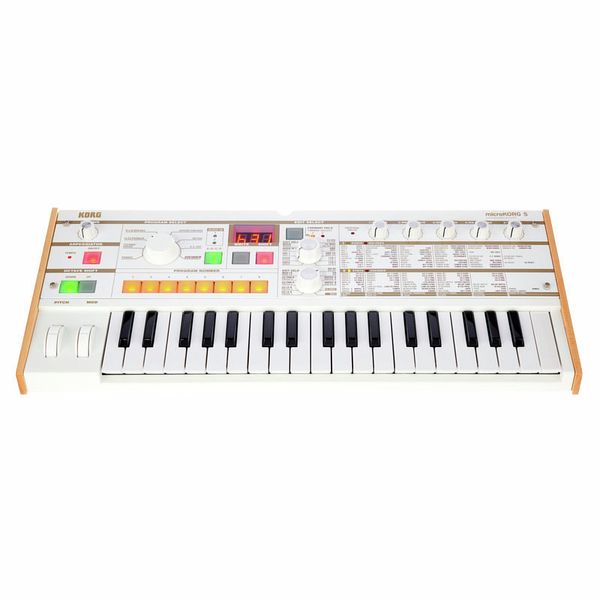
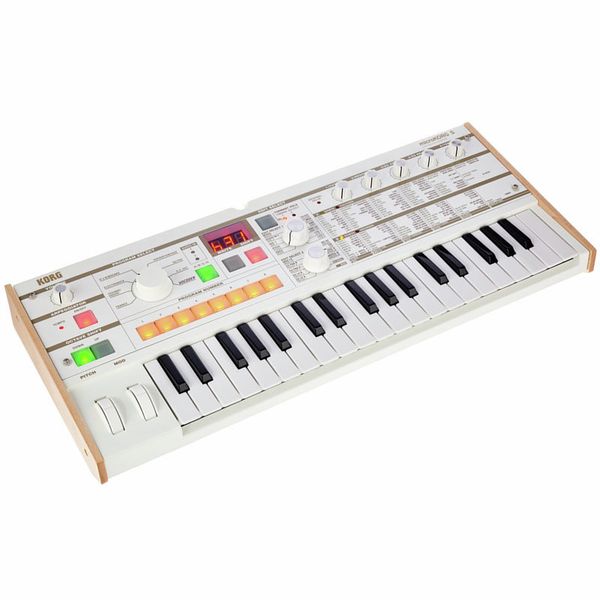
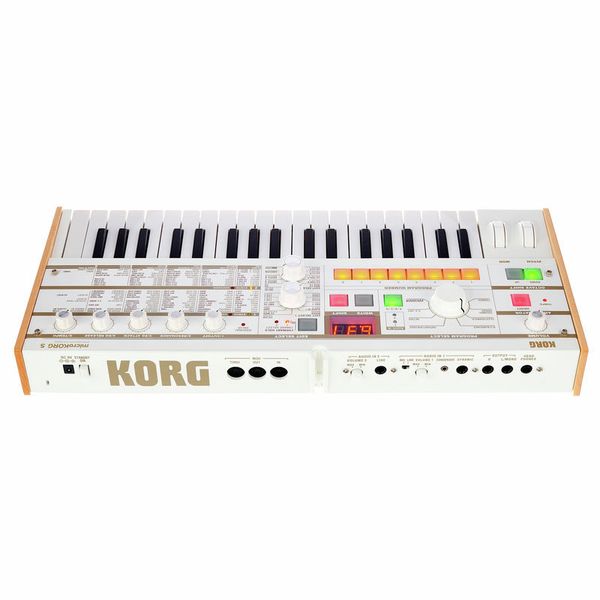
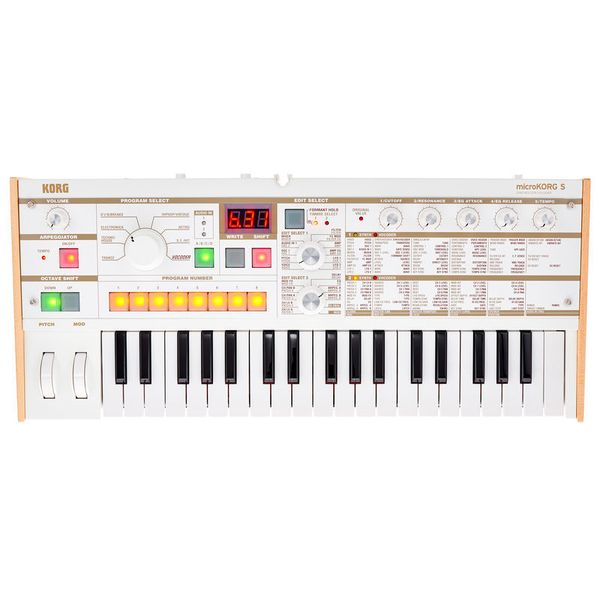
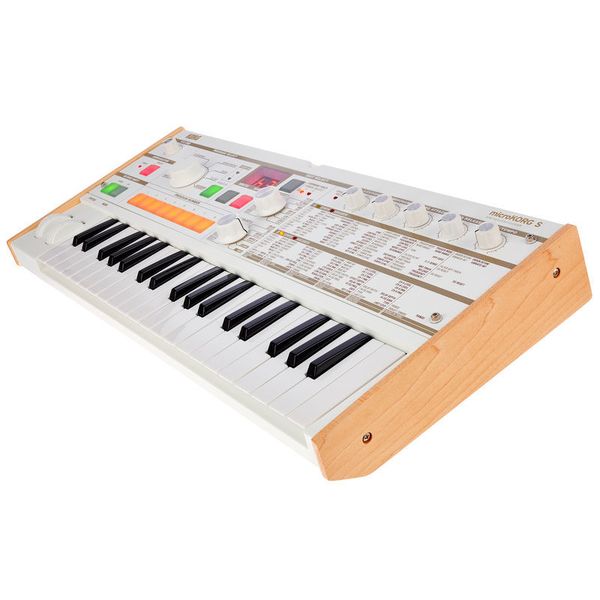
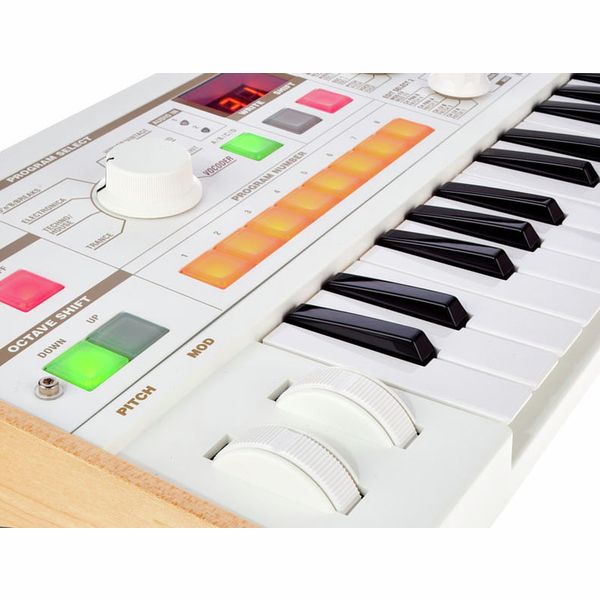
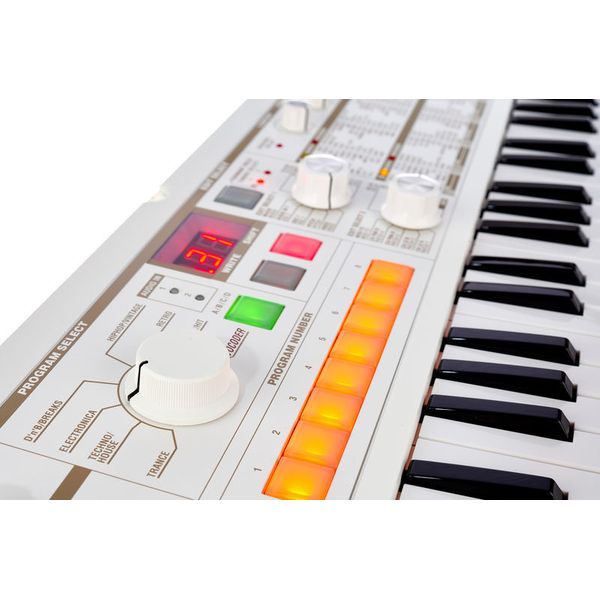
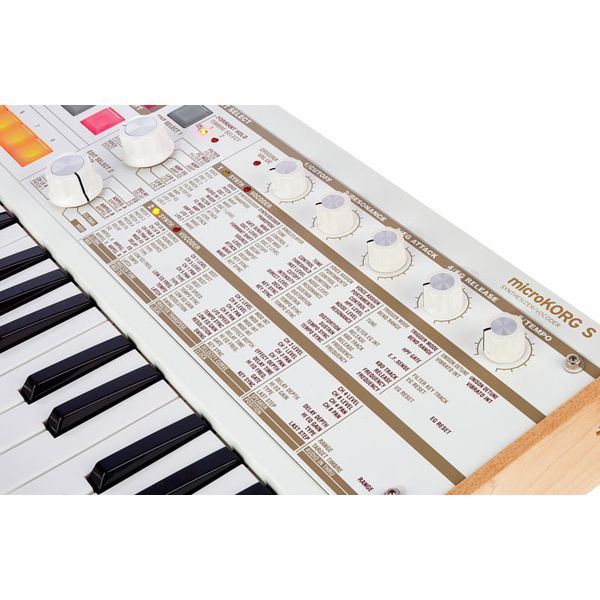
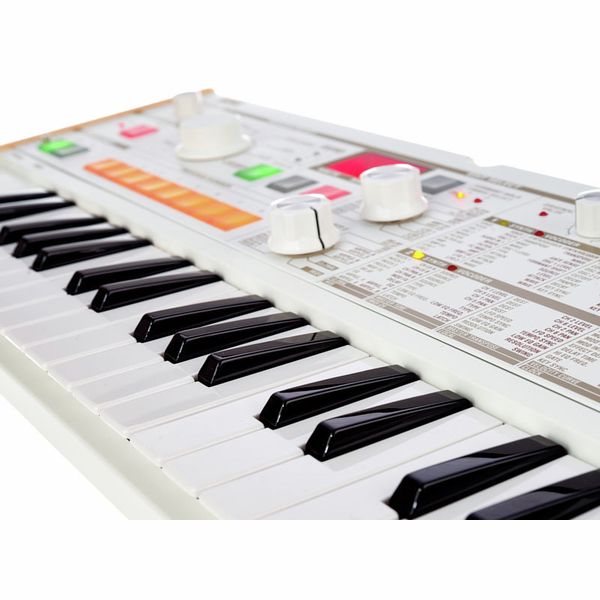
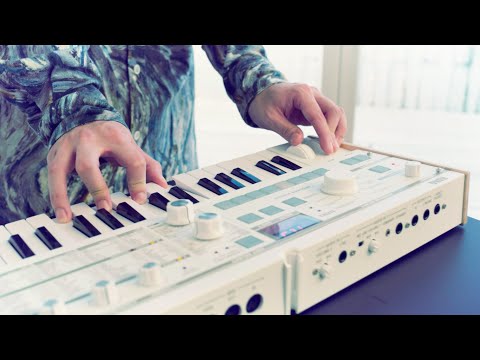
The microKORG S is a four-voice desktop synthesizer with an integrated vocoder and built-in 2.1 speaker system – the same DSP engine and 64 DWGS waveforms as the microKORG, in a form factor that operates as a fully self-contained instrument without an external amplifier or monitors. The dedicated woofer handles low-frequency content separately from the stereo mid-high drivers, giving the built-in sound a physical presence closer to an acoustic instrument than a laptop speaker. Factory programs cover House, Trance, Hip-Hop, and related styles; the sound engine runs to over 70 waveforms on the first oscillator alone, four filter modes, two ADSR envelopes, two LFOs, and a built-in distortion. A 37-key touch-sensitive mini keyboard, included vocoder mic, and distinctive retro styling complement the integrated 2.1 system. Battery operation – six AA cells – completes the standalone picture.
)
Playable musicality
Despite its emphasis on playable musicality – evident both in the velocity‑sensitive mini keyboard and the integrated vocoder mic – the microKORG S has a broad and flexible sound engine. Oscillator 1 provides the classic waveforms such as sawtooth, pulse, sine, and noise, while the second expands this palette with additional variations. There are also alternative algorithms to choose from, including Vox Wave and Cross Wave. The DWGS waveforms give artists access to more complex instruments like bells, electric pianos, guitars, and basses. With a total of 128 programs, the microKORG S offers a wide range of immediately playable sounds, all of which can be shaped further using the two-band EQ and resonant multi-mode filter, which switches between a 12dB two-pole low-pass, high-pass, and band-pass, and a steeper 24dB four-pole low-pass. The filter self-oscillates when pushed and responds to velocity and modulation, keeping even familiar patches alive under performance conditions.
)
Vocoder, speakers, and standalone use
The microKORG S's integrated vocoder uses the voice as a modulator, analysing its frequency content and transferring it to the carrier signal – the richer the carrier in harmonics, the more expressive the result. The 2.1 speaker system adds a dimension the standard microKORG doesn't offer: Low-frequency content from the dedicated woofer is felt through the instrument body as much as heard, a tactile quality closer to playing an acoustic instrument than monitoring through a separate speaker. Battery operation and self-amplification make the microKORG S a genuinely standalone instrument – practical for busking, rehearsal without a PA, mobile production setups, or any context where setting up a separate amplification chain isn't viable. The two audio inputs accept external sources in real time for live processing or vocoder use.
)
About Korg
For many years, the Korg brand has been synonymous with innovative synthesizers, workstations, keyboards, digital pianos, and more. With instruments such as the MS20, Polysix, Wavestation, KRONOS, and the Volca series (to name but a few), the Japanese company founded by Tsutomu Kato and Tadashi Osanai in 1963 has created legendary synthesizers whose names are music to the ears of many keyboard players. In addition, the Korg company is the inventor of the world's first handheld tuner, the WT-10. However, Korg has always stood for quality and innovation, not only in analogue synthesizers, digital workstations, arranger keyboards, and digital pianos, but also in guitar amplifiers. After Korg acquired the brand rights to Vox Amplification Ltd. in 1992, Korg expanded the Vox brand to include inexpensive digital guitar amplifiers with integrated modelling technology, in addition to new versions of the legendary AC30.
That real Korg sound
Vibrato, wah, and tremolo effects animate patches in performance, while the two LFOs – syncable via MIDI – handle rhythmic modulation in hybrid setups. A virtual patch matrix mirrors the classic signal flow of Korg's PS and MS series, with modulation source, destination, and intensity freely assignable. Full parameter access is available via the USB-MIDI interface and software editor, with settings displayable graphically and saveable as custom presets. For producers, performers, and anyone who needs a characterful, self-contained synthesizer that works wherever they take it – with or without a power outlet or PA system – the microKORG S is even more versatile than the standard microKORG.
