


da
Might be a good choice to start with
This is my first interface, so I can't compare but still few words about it.
Some say cheap plastic, well to me not that cheap, overall quality is ok.
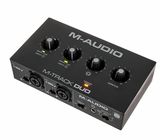
Sound quality is quite good to my ears too. I was going to by Solo model but 2 combo line/instr inputs of Duo made me change my mind and what I find really useful is a two separate knobs for monitors and headphones which Solo does not have, so if you want to play at night you just turn monitors off and headphones on with one move of the hand cause their location on the top is handy. What is not is that usb and monitor outputs are at the back and instruments and headphones are at the front so i just can't locate it on my table where i want it to be because of all that wires going different directions. However, the majority of interfaces are the same so i guess I am not allowed to complain.
Btw knobs are wobbling but you still can rotate it as precise as you need. Some also complained that at high levels the gain goes exponentially. My guitar start to clip at about 7 and i did not have issues with adjusting it and definitely there is enough more gain left.
The driver is available at manufacturers website and it could not be simplier, just 2 options of sample rate Khz and a buffer size slider. You will also get some free plugins which you will never use. My Duo works good only directly plugged in usb in of a pc but the quality drops if I plug it through a hub with DAW controllers, please bear it in mind if your limited in USB ins.
Imo good choice to have it as your first interface.
2
1
Report
TR
Great Budget Interface
I bought it in December 2022 and so far it's been a great tool.
The interface itself is very simple and honest. There's no trying to hard with it, you just plug it in and you can start using it.
I am buying a second one now to expand the number of channels to 4.
Really great tool for home studios.
The interface itself is very simple and honest. There's no trying to hard with it, you just plug it in and you can start using it.
I am buying a second one now to expand the number of channels to 4.
Really great tool for home studios.
0
0
Report
K
the best option for the price
0
0
Report
S
Excellent
.Very fast delivery. good packaging of products. And the interface works very well... previously I had one with a single channel... but this Duo... is much better... And the highlight, in this store I found the price of the product well below that offered by stores virtual.
Thanks Thomann
Thanks Thomann
0
0
Report
T
Easy to use and affordable
Everything works fine or as well as I can tell, except it has some kind of noise even if nothing is plugged in. Most of the time it doesn't really matter, but when recording guitars with high gain amp modelers it can get a bit rough. Nothing a noise filter can't fix though, so I guess it's allright.
0
0
Report
s
Avoid This Outdated E-Waste: A 16-bit Nightmare in 2026
If you are looking to ruin your recordings, buy this interface. It is a cheap, outdated piece of gear wrapped in modern marketing.
Here is why this interface belongs in the trash:
• Stuck in the Past (16-Bit Audio): We are living in 2026, yet this device uses 16-bit / 48 kHz resolution. That is CD quality from the 1980s. Serious modern recording requires 24-bit audio. With 16-bit, your dynamic range is heavily cut. You will get a high noise floor and annoying background hiss on every track.
• Cheap, Noisy Preamps: Do not let the fancy "Crystal preamp" name fool you. While a +60 dB gain looks good on paper, cheap preamps hiss like a snake when you turn them up past 50%. If you try to power a hungry microphone like a Shure SM7B, your audio will be buried under a mountain of static.
• Plastic, Lightweight Build: At just 0.365 kg (less than a pound), this thing is a toy. The moment you plug in two heavy XLR cables and a 6.3mm headphone jack, the weight of the cords will pull the interface straight off your desk. It feels cheap, hollow, and ready to break.
• Shared Monitoring & Output Bottlenecks: The USB/direct monitoring switch is a lazy fix for bad latency. If you use direct monitoring to avoid lag, you cannot hear your computer's effects in real-time.
The Verdict:
Do not waste your money. Saving a few bucks on a 16-bit interface will only force you to upgrade in a month when you realize your audio sounds thin, muddy, and unprofessional. Pass on this and buy a proper 24-bit interface from a reliable brand.
0
0
Report
s
M-Audio M-Track DUO
The entry-level sound card I think is the most recommended sound card. The sound is very good. It is worthy of the price. The friends who are just getting started can use this sound card. The sound is very good. Independent monitor speaker control and independent headphone volume control, you are all Can't imagine this sound card from this price, highly recommended
0
0
Report
M?
Noob E-Guitarrist :D
As a Beginner on music it feels the right choice, dont expect a focusrite finish here or quality in sound...for less than 50€ this is the best you can get!
0
0
Report
S
not enough gain, failed after a while
I've had this interface for around a year, it's pretty good for the price, there's just 2 issues:
For most dynamic microphones, this interface cannot produce enough (clean) gain to be usable without extra gain via software
After 8 months suddenly input 1 started producing a bunch of noise and the volume indicator LED would flash a lot, a week later the same thing happened with the second input and its LED so it was unusable and I ended up getting a higher end interface during Christmas
If you are just starting out as a musician and on a tight budget, this isn't a bad option but definitely make plans to get a higher quality one down the road.
Another thing that I didn't even notice until recently was that the Solo version of this interface actually has a 2nd input in the form of a 1/4" (guitar cable) plug, so if all you need is a mic and a guitar plugged in at the same time, you might as well save a few bucks and get yourself the solo version!
0
0
Report
e
Totally Perfect
This product is a very good option for beginners and its budget friendly. I really satisfied with performance.
0
0
Report