

To the page content

Hughes & Kettner Redbox 5 B-Stock

5.0 out of 5 stars from 4 customer ratings
B-Stock with Full Warranty
Return that may have slight traces of use.

DI Box

  • Industry standard for microphone free amp acceptance
  • Integrated box simulation
  • Three independently selectable filters for the sound adjustment of a 4x 12-cab simulation: Loose / Tight (response)
  • Large / Small (cabinet volume) and Vintage / Modern (speaker character)
  • Dimensions: 113 x 38 x 60 mm
  • Power supply via battery
  • Phantom power or power supply (not included): 10 mA, 9-15V AC or 9-24V DC
  • Weight: 200 g
  • Available since July 2013
  • Item number 320138
  • Sales Unit 1 piece(s)
Also available as brand new product 179 AED
166 AED 38,07 €
The price in AED is a guideline price only
Since we ship from Germany, additional costs through taxes and customs may be incurred
In stock

Three new features for the fifth generation

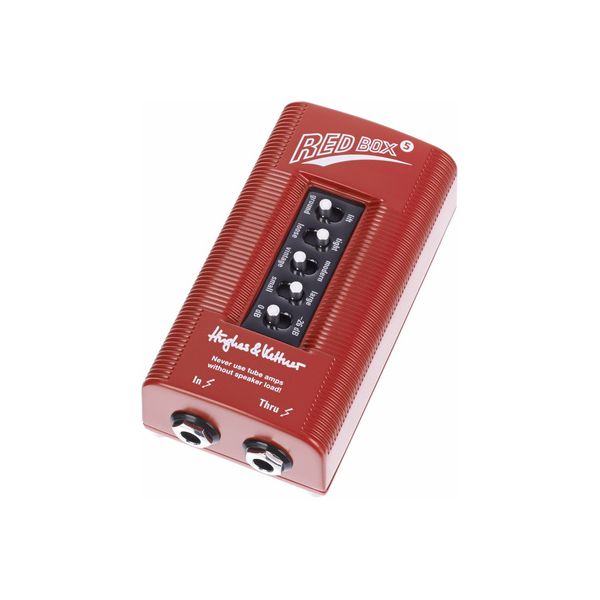
The legendary Hughes & Kettner Redbox is now in its fifth generation, and by now it's practically the industry standard for recording instrumental amplifiers without using a microphone – and without a lot of fuss. But the Redbox 5 is much more than just a simple DI box. In addition to the classic functions such as a ground/lift switch, the newest model here has three very interesting additional features: a tight/loose switch for the response, a modern/vintage switch for altering the sound being emulated, and even a small/large switch for selecting the size of the virtual cabinet. In addition, the levels can be set between 0dB and -26dB, which makes the Red Box 5 suitable for use with a huge range of instrumental amplifiers. Nothing has changed when it comes to this new generation's reliably robust construction, its characteristic red metal housing, and of course its compact size – all things that have helped cement this miniature classic's cult status.

Hughes & Kettner Redbox 5, front view with switches

Uncomplicated, flexible, effective

The Red Box 5 makes it easy to record amplifiers when a high-quality signal is important but there's no need – or perhaps no way – to actually mic up the amps. This little red box is simply connected between the amp's output stage and the cabinet: The balanced XLR output delivers the sound directly to the mixing console with remarkable clarity and presence. The Hughes & Kettner Red Box 5, like its predecessors, is just as suited to live use as it is when hooked up to a recording interface in the studio. It's powered by a 9V battery, although it's also possible to operate the Red Box on phantom power. In addition to its three filters, the adjustable characteristics of the virtual speaker, and of course its practical size, the Hughes & Kettner Red Box 5 also offers guitarists and bassists a number of other effective features, allowing them to adapt their instrument's output to the specific setting and circumstances.

Hughes & Kettner Redbox 5, XLR output

Every sound engineer's got one

Because it does away with the need for complicated mic setups, while simultaneously guaranteeing a perfectly clean signal from the amplifier with zero background noise, most studio techs will have already been using one of Hughes & Kettner's Red Box models for years. The little red box is an indispensable fixture of PA work, and it can be found in more or less every well-equipped sound engineer's toolkit. With the addition of the three filters, the fifth generation of this evergreen also makes it possible to process the sound to such an extent that there's scarcely any need to use a mixer to further correct it, be it live or in the studio – a high-quality signal quality is guaranteed.

Hughes & Kettner Redbox 5, Input and Thru

About Hughes & Kettner

Hughes & Kettner is one of the largest German suppliers of guitar and bass amplifiers. Founded in 1984 by Hans and Lothar Stamer under the name Stamer Musikanlagen GmbH, the manufacturer from St. Wendel in the Saarland can boast of its numerous innovations. For example, its first venture into the field of guitar amplifiers, the ASR64 from 1986, was the first programmable amplifier in the world. Thanks to its compact format, the Cream Machine of 1987 can be counted among the very first mini tube amplifiers. Equally influential were the Red Box analogue speaker simulation, the first six-channel amplifier (the Triamp), and the ZenTera, which used modelling technology in an integrated amplifier even before Line 6.

Don't mic the amp

Used between the output and the cab of a guitar or bass amplifier, the Red Box 5 delivers an unaltered and balanced signal directly from the amp to the mixer. This means there's no need to mic the amp for live gigs, which saves an enormous amount of time and also makes the mixer's job much easier. Often, a clean DI signal like this is used to complement the microphone pickup of an amplifier, in order to isolate the room sound and combine it with the dry signal to give a satisfying overall sound. The Hughes & Kettner Red Box 5 is an excellent tool for this purpose too, both live and in the studio.

4 Customer ratings

5 / 5

4 Reviews

google translate de
Unfortunately there was an error. Please try again later.
CF
Kommt gut rüber!
Christoph F. 05.11.2013
Die Redbox 5 von Hughes & Kettner habe ich mir angeschafft um mit einer Ampsimulation - ohne Boxensimulation am Ausgang anliegend - direkt das Signal an die PA zu schicken. Dafür habe ich je nach Anforderungssituation drei Geräte in meinem Fundus (tech 21 SansAmp Tri A.C., Boss FDR-1 und FBM-1). Alle drei preamps sind ohne eine Boxensimulation in einer direkten Signalkette vor einer PA nicht zu gebrauchen. gerdae im Highgain sind besonders hässliche Resultate bezüglich des Klangs zu erwarten. Ganz anders mit der Red Box 5: Dieses sehr hilfreiche Tool ermöglicht es doch tatsächlich zum Gig zu kommen ohne schwer schleppen zu müssen und einen erstklassigen Sound zaubern zu können. Dieser durchaus unter orthopädischen Gesichtspunkten sehr wertvoll Beitrag zur Gesundheit eines Gitarristen lässt mich alleine sehr zufreiden zurück mit diesem Setup.

Hardware/Verarbeitung:
Das Gehäuse ist sehr robust gearbeitet. Keine hervorstehenden Schalter die abbrechen können, wenn die Box mal von einer 4x12er Box fällt oder so. Sehr Kompaktes Gehäuse, was zudem in einer netten Soft-Tasche (liegt bei) transportiert werden kann. Von Innen ist es - so gut es zu diesem Preis eben geht - gegen Einstrahlungen von Außen abgeschirmt (ich hatte bis jetzt keine Probleme). Die Box ist sehr handlich und kann platzsparend sicherlich auch im Innenbereich neben dem Speaker eines halboffenen Combos/einer Box platz finden. Der Batteriewechsel kann ohne weiteres Werkzeug durchgeführt werden (Standfüße sind gleichzeitig Schrauben, die per Hand gedreht werden !!!GANZ DICKES LOB AN DIE DESIGNER!!!). In meinem Fall nutze ich aber die Option die Red Box 5 mit Phantompower vom Pult zu speißen.

Sound:
Die Red Box 5 bietet tatsächlich unterschiedliche Soundmodi an bei denen sich doch auch ein hörbarer Unterschied einstellen lässt. Ob man nun das ganz Vintage und Modern nennen musste, sei mal dahin gestellt. Der Begriff Vintage ist in meinen Augen sowieso im deutschen Sprachgebrauch sehr strapaziert. Jedenfalls sind die Vorstellungen der Entwickler von einer Vintage-Box eher meine, wenn es darum geht einen satten Klang rüber zu bekommen. Die Moderne Option sollte Highgainfreaks besser gefallen. der Thru-Ausgang macht genau das, was er soll. Wenn also ein Gitarrenamp zum Monitor auf der Bühne genutzt werden sollte, habt ihr darüber die Möglichkeit euch das Mikrofonieren des Amps zu sparen. Die Red Box 5 kann da sicherlich einen erheblichen Beitrag zur Entrümpelung der Bühne beitragen. was der Mischer durch die Red Box gesendet bekommt ist soundtechnisch durchaus zu gebrauchen und stellt eine gute Ausgangsbasis für druckvollen Sound dar. Natürlich kommt es aber auch darauf an, was man da rein schickt, aber das ist eine andere Diskussion.

Features/Bedienung:
In meinem Anwendungsbeispiel hätte ich mir eine Stufenlose Regelung des Ausgangspegels gewünscht. Aber selbst mit den beiden Optionen ist die Red Box 5 gut zu gebrauchen. Durch das Gehäuse und die Ausarbeitung ist auch gewährleistet, dass die Red Box 5 an Ort und Stelle verweilt und nicht der Last der Stecker unter der Einwirkung der Erdanziehung nachkommt.
Alles in allem ein Klasse Teil und genu das, was ich zu meinen Setup gesucht habe. Eine richtig gute Alternative zur Mikrofonierung auf der Bühne ist ebenfalls zu attestieren. In diesem Punkt sollte man aber unbedingt für sich den Hörtest machen. Es gibt Konkurrenzprodukte die nicht so viele Optionen haben, aber eventuell die eigenen Soundvorstellungen besser treffen.
8
3
Report

Report

google translate de
Unfortunately there was an error. Please try again later.
B
Abnahme ohne Mikro!
Basti7 31.07.2013
Ich hatte die Redbox bis jetzt nur kurze Zeit im Proberaum im Einsatz, deshalb kann ich über Dinge wie Haltbarkeit, etc. nichts sagen.
Die Bedienung ist denkbar einfach. Die Redbox (in meinem Fall) zwischen Amp und Lautsprecher und das Signal direkt ins Mischpult. Fertig. Die Abnahme klingt für meine Ohren super, aber das muss jeder für sich beurteilen.

Alles in allem eine klanglich sehr gute Alternative oder Ergänzung zur Abnahme mit Mikro und das bei wirklich einfacher Bedienung. Ich werde die Redbox auf jeden Fall zum nächsten Gig mitnehmen.
Einen kleinen Abzug, könnte man höchstens dafür geben, dass kein Netzteil mitgeliefert wird.
2
1
Report

Report

google translate de
Unfortunately there was an error. Please try again later.
J
Klein - rot - gut.
Jörg900 06.12.2013
Dieses kleine Teil erfüllt wirklich seinen Zweck. Der Klang ist amtlich gut. Gewünscht hätte ich mir noch eine Funktionsled plus Spannungsversorgung über den angeschlossenen Verstärker. Aber das geht wohl nur bei Teilen mit Dummyload wie bsplw. von Kochamps etc. Ansonsten alles gut und geldwert.
0
0
Report

Report

google translate de
Unfortunately there was an error. Please try again later.
C
Eine Redbox mit Charakter
Chryssanthos 30.10.2013
Wie sagt oft ein Gitarrist. Mein Instrument tröstet oder inspiriert mich. Oft fehlt dann die richtige Klangumsetzung, die man bisher oft mit sägenden Gitarren zunichte machte wenn man eine Aufnahme tätigen wollte.

Ich bin froh, dieses Teil nun zu besitzen. Danke!
0
0
Report

Report